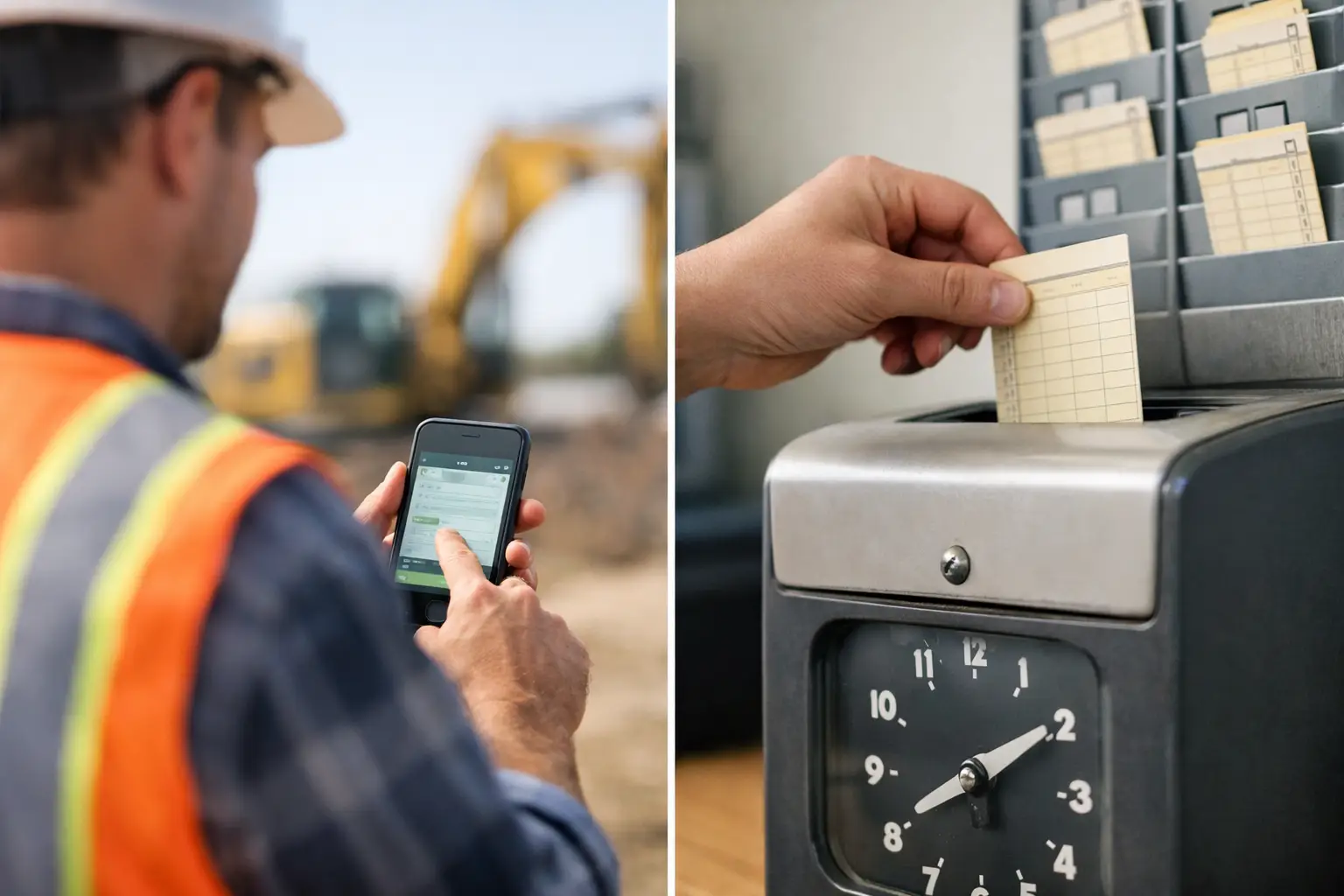
A crew management software review should answer one question before anything else: will this make the next workday easier for your field crew and office team?
For subcontractors, that question matters more than a long feature list. Your foremen need to clock a crew into the right job, record what happened, and move on. Your office needs accurate labor, job progress, photos, materials, and documentation without chasing text messages or deciphering paper timecards. If the software adds steps, requires constant training, or only works well from a desk, it will create another problem instead of fixing one.
What Crew Management Software Should Do for a Subcontractor
Crew management software is often sold as a scheduling or timekeeping tool. Those functions matter, but they are only part of the job. A useful system gives you a clear view of who is working, where they are working, what work was completed, and what that labor cost belongs to.
For a concrete contractor, that may mean a foreman clocks the crew into a foundation pour, attaches job photos, notes a delayed delivery, and records the equipment used. For an electrical contractor, it may mean tracking labor against a service call or tenant buildout before payroll and billing get ahead of the paperwork.
The right platform connects those daily actions to job records the office can trust. The wrong one leaves the same information spread across timecard apps, spreadsheets, group texts, and file folders.
Crew Management Software Review: What to Compare
Do not judge crew management tools by the number of screens they offer. Judge them by how quickly a foreman can complete the work that has to happen every day, and how much follow-up the office still has to do afterward.
Field adoption comes first
A system can have detailed reports and still fail if crews will not use it. Field adoption usually comes down to a few basics: a clean mobile experience, large and obvious actions, and workflows that make sense without a manual.
Ask to see the actual clock-in process. Can a foreman select a job, assign workers, and submit time in a minute or two? Can they correct a missed punch without calling the office? Can they add a daily note or photo while standing at the jobsite?
Be cautious when a demo relies heavily on phrases like “fully configurable.” Flexibility has a place, especially for larger companies with unusual approval rules. But every extra field, dropdown, and approval path creates another reason for a busy crew leader to skip the process. Most subcontractors need a system that handles real jobsite work out of the box.
Job-level labor visibility
Basic time tracking tells you who worked eight hours. Crew management should tell you where those eight hours went.
Look for job and cost-code tracking that is simple enough to use consistently. If labor is only assigned to a general department or a vague project name, you cannot see which jobs are gaining ground and which ones are eating margin. The goal is not to make foremen do accounting. The goal is to give owners and project managers reliable labor data before a job is finished.
This is especially valuable when crews move between jobs in one day. A landscape crew may start at a commercial site, run to a punch-list job, then finish at a residential install. The software should let the foreman record those changes accurately without making three separate paper timecards.
Daily documentation that does not get ignored
Good job records protect your company when memories fade and questions show up weeks later. Daily logs, job photos, weather notes, material receipts, production updates, and change documentation all have value. But only if they are captured while the details are fresh.
Review how documentation works in the field. Can a crew leader add photos directly to the correct job? Are daily logs fast enough to finish before heading home? Can the office find those records later without searching through a personal phone or a text-message thread?
A tool that makes documentation feel like an extra office task will not get used consistently. One that puts time, photos, notes, and job activity in the same daily workflow has a much better chance of becoming standard practice.
Scheduling without false precision
Scheduling is useful, but construction schedules change. Rain, inspections, late materials, equipment breakdowns, and customer changes can move a plan in minutes.
Look for scheduling that gives crews a clear answer about where to be and what to bring, while allowing the office to adjust quickly. A color-coded calendar is not enough if the schedule stays trapped in the office. Workers and foremen need current job information on their phones.
There is a trade-off here. Highly detailed scheduling systems can work for companies with dedicated dispatchers and tightly repeated workflows. For many subcontractors, a simpler job schedule that crews actually check is more valuable than a complicated plan nobody keeps current.
Equipment and materials tied to the work
Labor is not the only cost that can disappear into a spreadsheet. Equipment hours, material usage, deliveries, and rental costs can change whether a job is profitable.
If your crews run skid steers, lifts, trailers, saws, or specialty equipment, review whether the system can record that use against the job. The same applies to materials. You do not need warehouse software to benefit from knowing which job received a delivery or used additional supplies.
The best fit depends on your trade. A framing contractor may care most about labor and job photos. A grading contractor may need stronger equipment tracking. A plumbing company with service work may prioritize dispatching, customer details, and fast job closeout. Start with the costs and handoffs that cause the most confusion in your business.
Watch for These Common Problems
Some software looks impressive in a sales demo because it was built for a general contractor managing a large project. That does not automatically make it a good fit for a subcontractor managing several field crews.
First, watch for complexity that gets pushed onto your team. If setup requires a consultant, weeks of configuration, or a full-time administrator, calculate that cost honestly. You may need advanced controls, but a small or mid-sized subcontractor should not have to become a software expert to see who is on a job.
Second, check the pricing model. Per-user charges can become expensive when you add seasonal workers, new crews, or office staff who need visibility. Ask whether jobs, employees, storage, mobile access, onboarding, and support are included or treated as add-ons.
Third, do not assume an accounting integration solves every problem. Integration is valuable when labor, invoices, and job details move cleanly into your accounting process. But it still depends on accurate field data. Review how the software handles approvals, corrections, and exports before payroll week exposes gaps.
Finally, ask what happens when internet service is weak. Many jobsites have spotty coverage. Your crews need a mobile workflow that is practical in the conditions where they actually work, not just on a strong office Wi-Fi connection.
A Better Way to Test Your Shortlist
Before you commit, test each platform using one of your real jobs. Do not use a generic sample project supplied in the demo. Choose a job with a working crew, active labor, photos, equipment or materials, and a deadline.
Have a foreman complete the daily workflow from a phone. Then have the office find the time, notes, and photos, review labor by job, and prepare the information needed for payroll or billing. If either side gets stuck, that is useful information.
Ask these practical questions during the test: How many taps does a crew leader need to submit time? Can the office see today's activity without calling the field? Can a missing detail be corrected quickly? Will a new employee understand the basics on their first day?
SimplySub is built around that kind of subcontractor workflow, combining crew time, job tracking, daily logs, photos, equipment, materials, invoices, and QuickBooks integration in one field-friendly system. The point is not to give crews more software to manage. It is to replace the paperwork and disconnected tools that slow down the work.
Choose the Tool Your Crew Will Actually Use
The best crew management software is not necessarily the one with the biggest feature list. It is the one that gives your field team a simple daily routine and gives your office dependable job information without extra chasing.
Start with the friction you want to remove this month: late timecards, unclear job costs, missing photos, scattered paperwork, or crews calling in for schedule details. Then choose the system that makes that specific work easier on a real jobsite. When the field can use it without a fight, better visibility and better control follow naturally.